My blog
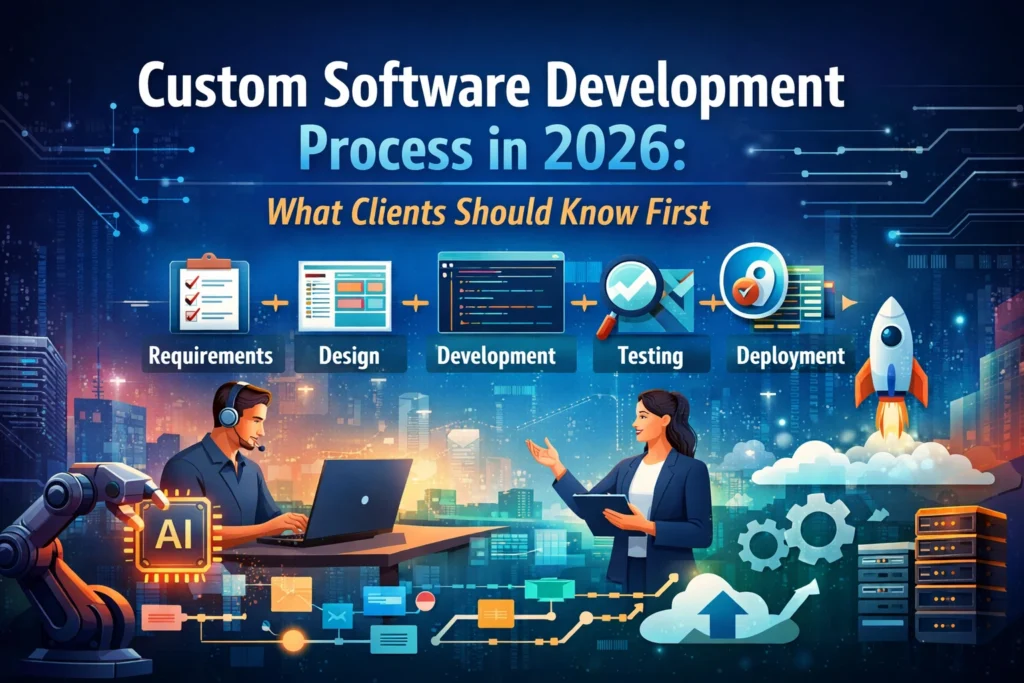
The custom software development process in 2026 has transformed dramatically from traditional models. Businesses now demand software that not only solves immediate problems but also supports long-term strategic goals. For clients considering custom software development in Kolkata, understanding this process is critical before making any investment.
Modern clients are more informed and selective. They want solutions that are scalable, secure, maintainable, and aligned with business objectives. By understanding the customized process for software development, clients can actively contribute to shaping a product that truly reflects their vision while avoiding common pitfalls that lead to delays, budget overruns, or technical debt.
Whether your project involves mobile application development in Kolkata, IoT solutions, or enterprise software, a deep understanding of the process helps clients ask the right questions, evaluate potential partners, and make smarter, long-term decisions.
Why Clients Should Understand the Custom Software Development Process
Understanding the custom software development process in 2026 is more than just “technical knowledge”—it’s about strategic empowerment. Clients who know the process can:
- Communicate effectively with developers: When you understand phases, you can articulate your expectations, provide timely feedback, and reduce misunderstandings.
- Anticipate timelines and budgets: Awareness of stages, dependencies, and testing cycles helps clients realistically plan and allocate resources.
- Identify risks early: Knowledge of potential bottlenecks or integration challenges enables proactive mitigation.
- Evaluate quality and expertise: Understanding the process allows clients to assess a team’s competence, whether it’s in mobile application development in Kolkata or complex IoT systems.
Insightful clients also appreciate that modern development is iterative, not linear. Each stage builds on the previous, allowing flexibility for feedback, which is especially important in projects with evolving requirements.
Key Stages of the Custom Software Development Process
The custom software development process in 2026 consists of several critical stages. A client-centric understanding of each stage ensures a smoother experience and better alignment with business goals.
Requirement Gathering & Analysis
Requirement gathering is the foundation of success. A thorough process ensures developers understand business goals, user expectations, and technical constraints.
Clients should actively participate in:
- Business goal clarification: Defining objectives beyond immediate needs, considering long-term scalability.
- Functional requirement detailing: Outlining core functionalities, integration needs, and desired performance.
- Non-functional requirements: Performance, security, compliance, and usability metrics.
Insight: Many clients underestimate non-functional requirements. For example, in custom software development in Kolkata, a small oversight in security or scalability requirements can lead to costly rewrites later. Engaging early and reviewing detailed requirement documents prevents surprises and ensures alignment.
Design & Prototyping
Design marks the point at which abstract ideas start taking a concrete form. Using design methodology in IoT or mobile-first principles, development teams create wireframes, mockups, and interactive prototypes.
Key benefits of prototyping include:
- Early visualization: Clients see the product’s look, feel, and functionality before development begins.
- Feedback loops: Quick iterations ensure client expectations are met without significant resource wastage.
- Risk reduction: Design flaws are identified early, avoiding delays and extra costs.
Insight: Prototyping is especially critical for IoT projects where device interaction and mobile application development in Kolkata integration can have complex dependencies. Clients who actively review prototypes often end up with a product that feels intuitive and user-friendly from day one.
Development & Implementation
Development transforms design into working software. Agile and iterative approaches dominate modern custom software development process in 2026, allowing for faster feedback and flexible adaptation to changes.
Clients should be aware that development includes:
- Backend logic creation: Building the core architecture that supports all functionalities.
- Frontend development: Creating interfaces for end-users, particularly in mobile applications.
- Integration with third-party systems or IoT frameworks: Ensuring seamless interoperability.
- Code reviews and quality checks: Maintaining maintainability, scalability, and security.
Insight: Active client involvement, such as reviewing intermediate builds or testing features in a sandbox environment, improves alignment. For instance, in mobile application development in Kolkata, early client feedback on UI/UX reduces costly iterations later.
Testing & Quality Assurance
Testing is no longer just about finding bugs. It ensures software reliability, security, and performance.
- Key Testing Areas Include:
- Functional correctness to meet requirements
- Security audits for data protection
- Performance under various load conditions
- Cross-platform and device compatibility
Insight: Clients who understand testing stages can request additional checks relevant to their business. For example, e-commerce clients may require stress tests to simulate heavy user traffic, while IoT projects need connectivity and security testing. Awareness of these testing nuances ensures clients receive software that is both robust and reliable.
Deployment & Maintenance
Deployment is only the beginning. Successful software requires maintenance in custom software development process for long-term efficiency.
- Maintenance Includes:
- Regular updates for features and security
- Performance optimization
- Scalability adjustments
- Bug resolution
Insight: Clients often underestimate post-launch care. A software solution without proper maintenance risks downtime, vulnerabilities, and user dissatisfaction. Discussing SLAs, update schedules, and monitoring tools ensures the software evolves with business needs and remains competitive.
Why a Customized Process Matters
A customized process for software development is critical because one-size-fits-all approaches rarely meet unique business needs.
Benefits of a customized process include:
- Tailored architecture suited to specific business requirements
- Integration with existing enterprise systems
- Enhanced user experience and workflow optimization
- Flexibility for scaling as the business grows
Insight: Clients who understand customization can ask meaningful questions about frameworks, architecture, and integration capabilities. This ensures they are not left with a generic solution that cannot adapt to future business needs.
Design Methodology in IoT
IoT solutions demand a structured approach. A strong design methodology in IoT ensures:
- Devices and software communicate seamlessly
- Interfaces are intuitive and accessible
- Security protocols protect sensitive data
- Systems remain scalable for growing device networks
Insight: Clients should evaluate development teams’ methodology for IoT projects. Teams that emphasize robust design frameworks often deliver solutions that are reliable, secure, and future-ready. Understanding the methodology allows clients to anticipate challenges and plan for device integration, monitoring, and analytics.
Mobile Application Development Considerations
For businesses targeting mobile users, mobile application development in Kolkata has become a strategic priority. Clients should consider:
- Platform choice: Native iOS/Android or cross-platform frameworks
- Intuitive UI/UX design for higher engagement
- Backend integration with databases and existing software
- Post-launch support and updates
Insight: Active involvement in reviewing app prototypes ensures functionality aligns with user expectations. Clients familiar with the mobile development lifecycle often achieve faster adoption and reduced support issues.
Evaluating a Development Partner
Choosing the right development partner is crucial. Clients should assess:
- Proven experience in custom software development in Kolkata
- Transparency about their customized process for software development
- Technical expertise in IoT, web, and mobile applications
- Maintenance and support capabilities
- Positive client testimonials and case studies
Insight: A knowledgeable client can gauge the team’s capability to handle complex requirements. Asking specific questions about design, testing, and AI integration ensures the project is in capable hands.
AI and Automation in 2026 Development
AI is redefining software development. Clients should understand its applications in the custom software development process in 2026:
- Automated testing to detect bugs faster
- Predictive maintenance to prevent system failures
- Data-driven insights for feature optimization
- AI-assisted coding to accelerate development
Insight: Clients who leverage AI awareness can request smarter solutions, reduce manual errors, and ensure faster delivery timelines. AI also allows for continuous improvement post-launch, enhancing user experience and operational efficiency.
Conclusion: What Clients Should Take Away
Understanding the custom software development process in 2026 empowers clients to make informed decisions and select the right development partner. By familiarizing themselves with:
- Requirement gathering, design, and prototyping
- Development, testing, and deployment
- Design methodology in IoT and mobile application development in Kolkata
- Maintenance in custom software development process
- Tailored approaches in customized process for software development
…clients can confidently invest in software that meets their immediate needs and adapts to future business challenges.
Knowledge is power in 2026. Clients who understand the process ensure software is scalable, secure, and high-performing while reducing risks and maximizing ROI.
Frequently Asked Questions
1. What is Custom Software Development?
Custom software development is the process of designing, creating, deploying, and maintaining software that is tailored specifically to meet the unique requirements of a business or organization. Unlike off-the-shelf software, custom software is built to solve specific problems, support unique business processes, and scale as the organization grows.
Key points:
- Developed for specific users or organizations
- Focuses on business goals and workflows
- Flexible, scalable, and maintainable over time
- Can integrate with existing systems or IoT devices
- Often used for enterprise applications, mobile apps, or specialized software solutions
Example: A logistics company in Kolkata may need a custom tracking system that integrates GPS, warehouse management, and delivery scheduling. Off-the-shelf software may not fit all its operational needs, so custom software development is preferred.
2. What are the seven key steps involved in building software from concept to deployment?
The software development process typically follows 7 main stages, ensuring quality and alignment with client goals:
- Requirement Analysis – Gathering and analyzing business needs, functional and non-functional requirements.
- Feasibility Study – Evaluating technical, operational, and financial feasibility.
- System Design – Creating software architecture, UI/UX design, and database structure.
- Implementation (Coding/Development) – Writing code and integrating systems according to design specifications.
- Testing – Conducting functional, security, performance, and usability testing.
- Deployment – Launching the software for end-users or production environment.
- Maintenance & Support – Updating features, fixing bugs, and scaling the system over time.
Insight: In 2026, agile and iterative methods often combine these stages, allowing incremental delivery and faster feedback loops.
3. What are the 5 Phases of SDL (Software Development Life)
SDL generally refers to Software Development Lifecycle (SDLC) phases. Sometimes SDL is used interchangeably with SDLC but in a condensed 5-phase model:
- Planning – Defining objectives, resources, and project roadmap.
- Analysis – Gathering detailed requirements and understanding business needs.
- Design – Creating architecture, UI/UX, database schemas, and system models.
- Implementation – Coding, integration, and unit testing of modules.
- Testing and maintenance include thorough quality checks, deploying the software, and performing regular updates to keep it running smoothly.
Note: These 5 phases are essentially a simplified version of the 7-stage process, often used in agile or iterative approaches.
4. What is the Difference Between SDL and SDLC?
- SDL (Software Development Life): Often a conceptual framework focused on the lifecycle of software from planning to maintenance. It may emphasize stages broadly without strict documentation.
- SDLC (Software Development Life Cycle): A structured methodology that defines detailed steps, processes, and standards for software development. SDLC is formalized and usually includes models like Waterfall, Agile, Spiral, or DevOps.
In short:
- SDL = Conceptual lifecycle of software
- SDLC = Structured, documented methodology to develop software
5. What is L1, L2, L3, and L4 in Software Development?
L1–L4 usually refer to support or escalation levels in IT and software development. They indicate levels of problem-solving and technical support:
- L1 (Level 1 Support) – Basic support or first point of contact. Handles simple issues, general queries, and basic troubleshooting.
- L2 (Level 2 Support) – More specialized support. Handles issues requiring deeper technical knowledge or software configuration expertise.
- L3 (Level 3 Support) – Expert-level support, usually involving developers or architects. Handles complex issues, bugs, or source code-related problems.
- L4 (Level 4 Support) – External or vendor-level support. Involves third-party software providers or specialized experts when internal teams cannot resolve the issue.
Example: If a company’s custom software crashes:
- L1 may restart the system or check basic configurations
- L2 may debug code modules
- L3 may fix complex bugs in source code
- L4 may involve a third-party vendor if a framework or library causes the issue
My blog is proudly powered by WordPress